







“Jetrel”
Written by James Thornton & Scott Nimerfro and Jack Klein & Karen Klein and Kenneth Biller
Directed by Kim Friedman
Season 1, Episode 14
Production episode 115
Original air date: May 15, 1995
Stardate: 48832.1
Captain’s log. Neelix and Tuvok are playing pool against each other on Chez Sandrine holodeck program, with Paris and Gaunt Gary observing and giving playing advice, when Janeway summons Neelix to the bridge. A Haakonian is asking for Neelix by name. Neelix reveals that the Haakonians and the Talaxians were at war for a long time, and when the Haakonian reveals himself to be Dr. Ma’bor Jetrel, Neelix stomps off the bridge in disgust.
Jetrel is a mass murderer, the scientist who created the Metreon Cascade, a brutal weapon that wiped out hundreds of thousand on the Talaxian colony of Rinax, including Neelix’s entire family. Neelix himself was home on Talax at the time, though he was involved in rescue efforts.
Janeway greets Jetrel when he comes on board, saying that she will speak for Neelix, as he wants nothing to do with Jetrel, who expected that response. He’s attempting to find a cure for metremia, a fatal blood disease that many who have been exposed to the aftereffects of the cascade are suffering from. Jetrel is concerned that Neelix may have the disease, plus screening him for metremia will give him for data toward a cure.
Buy the Book
Network Effect
Neelix is skeptical that the person responsible for killing so many Talaxians is suddenly interested in helping Talaxians, but after being gently bullied by both Kes and Janeway, he agrees to be examined. When he finally meets Jetrel, Neelix remains suspicious of his motives. He almost walks out on him, but is convinced to help in order to aid other Talaxians that have the disease.
Jetrel examines Neelix and declares that he does have metremia.
Neelix tries to put a bright face on it—now he doesn’t have to be concerned that he will outlive Kes, which has been a worry given Ocampans’ short lifespans—but Jetrel thinks Voyager‘s transporter technology may be the key to the cure. They can beam a piece of the cloud that is choking Rinax’s atmosphere into a containment unit. Haakonian science isn’t capable of just carving out a piece of cloud like that, but the transporter can do it easily. Despite it being very much out of their way, Janeway changes course to Rinax. Jetrel stumbles on his way out of Janeway’s ready room, but he fobs it off as the stress of dealing with Neelix.
Neelix talks further with Jetrel, describing his experiences with the horribly mutated survivors of the cascade. Jetrel admits that he hasn’t apologized because no apology could possibly be adequate for what he’s done. His own wife and children left him because they thought he was a monster, and when the cascade destroyed Rinax, he feared they may have been right. Neelix expresses his desire that Jetrel live with that guilt for a very long time, but Jetrel says he won’t get his wish: Jetrel himself is dying of metremia.
After suffering nightmares, including one where he sees Kes as a burned, mutated victim of the cascade, Neelix confesses to Kes that all his tales of derring-do as part of the Talaxian military were lies. He wasn’t on Talax when the cascade hit fighting for his people, he was on Talax hiding from conscription. He was a coward, refusing to fight, and while he hid, his family was massacred.
They arrive at Rinax, and Janeway calls Neelix to the bridge. However, he finds the memory of this place too painful, and he leaves.
Torres beams the cloud segment aboard. Jetrel brings the containment field to sickbay, and starts to work on it—after deactivating the EMH and rendering Neelix unconscious with a hypospray when he enters sickbay. Jetrel then goes to the transporter room.
Janeway, however, calls sickbay for an update, and when nobody responds, she reactivates the EMH. They track Jetrel to the transporter room and Tuvok shuts it down. Janeway and Tuvok head to the transporter room, joined by the revived Neelix.
Jetrel explains his true purpose: to isolate the individual patterns in the cloud to reintegrate the people who were disintegrated by the cascade. Haakonian scientists rejected the notion, and Janeway likewise thinks there are too many variables for it to possibly work. But both Neelix and Jetrel plead with her to let him try it. (Jetrel also reveals that Neelix is not dying of metremia, that was just a ruse.)
Reluctantly, Janeway agrees, and she and Tuvok attempt the procedure. But it’s impossible to achieve cohesion, even with the transporter’s assistance. After it fails, Jetrel collapses.
Neelix visits the dying Jetrel in sickbay and forgives him.
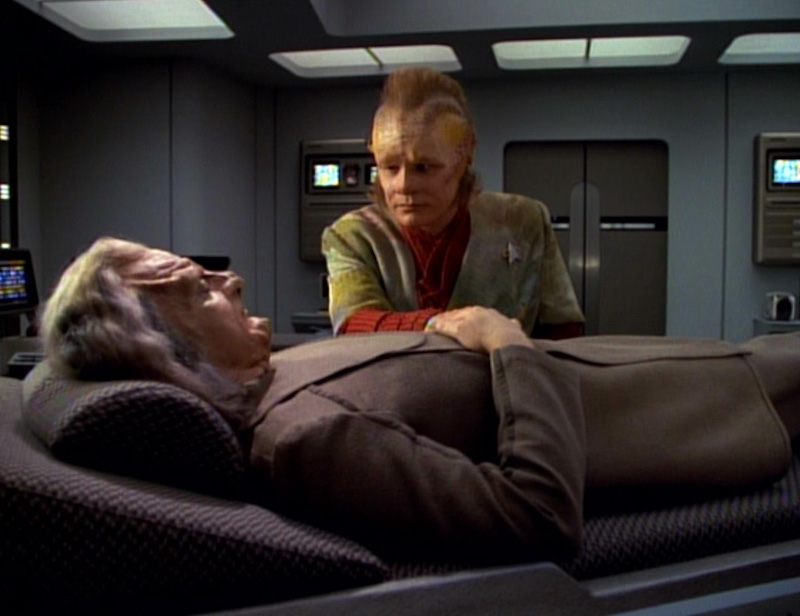
Can’t we just reverse the polarity? Jetrel thinks he can use the transporter to reintegrate the people vaporized by the cascade. This strikes me as a horrible idea, especially since reconstituting their bodies doesn’t mean it’ll reconstitute their personalities—on the other hand, this is a great way to bring about a zombie apocalypse…
There’s coffee in that nebula! Janeway is compassionate and understanding throughout all of this, trying her best to help Jetrel find a cure, to help Neelix help his people, and to save Neelix’s life. She even attempts Jetrel’s crazy-ass notion to resurrect the dead Talaxians.
Please state the nature of the medical emergency. Janeway has fulfilled her promise to give the EMH the ability to turn himself off, as he does so in this episode—and Jetrel remembers the words used in order to shut him off again.
Everyone comes to Neelix’s. We get Neelix’s full backstory in this episode, including that his entire family was wiped out by the Metreon Cascade, and also that his history with the Talaxian military is entirely made up, as he avoided conscription.
What happens on the holodeck stays on the holodeck. We return to Sandrine’s, and learn that, since “The Cloud,” Neelix has learned how to play pool, and that Tuvok plays as well. We also see Tuvok miss a called shot rather badly.
Do it.
“I’m simply a scientist. Yes, I developed the weapon, but it was the government and the military leaders who decided to use it, not I.”
“That must be a very convenient distinction for you. Does it help you sleep at night?”
–Jetrel rationalizing and Neelix calling him on it.
Welcome aboard. James Sloyan appears in his fourth of four roles on Trek, having played Admiral Jarok in TNG‘s “The Defector,” Dr. Mora Pol in DS9’s “The Alternate” (and again later in “The Begotten“), and the adult version of Worf’s son Alexander in TNG’s “Firstborn.” Here he plays the title role of Dr. Ma’bor Jetrel.
In addition, Larry Hankin returns as Gaunt Gary, the pool hustler at Chez Sandrine last seen in “The Cloud,” and who will next appear in “Twisted.”
Trivial matters: Scripter Ken Biller did considerable research into the Hiroshima bombing in the waning days of World War II, and Jetrel was consciously patterned after J. Robert Oppenheimer, the chief scientist behind the Manhattan Project that developed the atomic bomb. Some of Jetrel’s dialogue was inspired by things Oppenheimer said.
Voyager visits the Talaxian home system for the first time, which Chakotay describes as a significant detour. Presumably it’s proximate to where Neelix came on board with Kes, though not necessarily that close, especially if they’re close enough for Jetrel to have found Voyager.
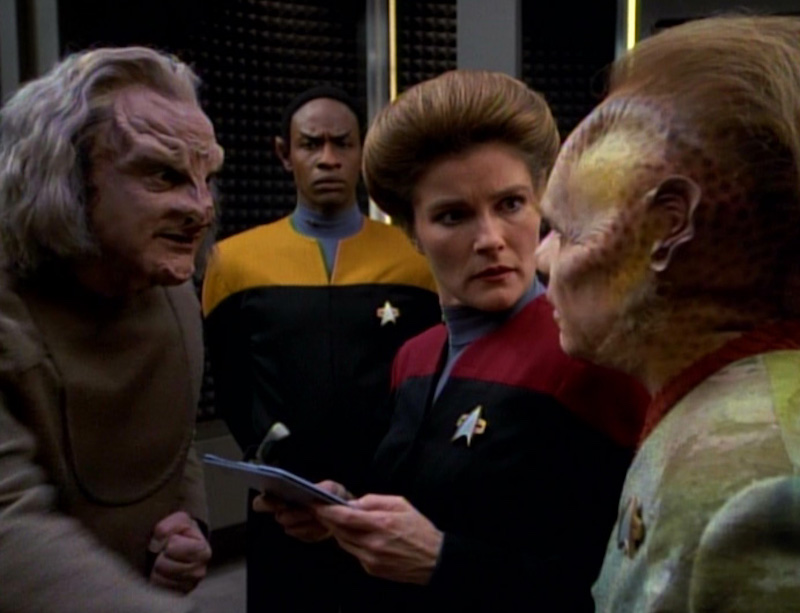
Set a course for home. “There is no way I could ever apologize to you, Mr. Neelix.” Just as with Rene Auberjonois over on DS9, my first exposure to Ethan Phillips was on Benson. The Robert Guillaume-starring sitcom was one of my favorite shows as a kid, and I thought Phillips was great on it. Similarly, Phillips was superb as a Ferengi scientist in TNG’s “Ménàge à Troi” (for all that the episode was mostly awful).
So it was very disappointing to see this talented actor reduced to an exaggerated caricature, coming across most of the time like the doofy comic-relief character that a lot of 1960s and 1970s animated series shoved in to get the yuks.
Which is why I unreservedly adore this episode and think it’s one of Voyager’s best.
I said back in the rewatch of “Caretaker” that Neelix was at his most interesting when he had an edge to him, which he had during the rescue of Kes from the Kazon and its immediate aftermath, and which has been depressingly absent from the dozen or so episodes in the interim. But it’s back in full force in “Jetrel,” and it’s a joy to see. Freed from having to be the goofball, Phillips shines. The roller-coaster of emotion in his performance is superb, from his near-panic attack when Jetrel identifies himself to his frustrated disgust when Janeway and Kes try to convince him to see Jetrel to his pure contempt when he first confronts Jetrel (the line quoted in the “Do it” section above about convenient distinctions may be Phillips’s best moment in the entire seven-year history of the show) to his depressed hiding in the mess hall until Kes finds him to his passionate retellings of his experiences on Rinax to both Jetrel and the bridge crew. It’s a bravura performance, bringing depth to a character who was utterly bereft of it up until this point.
And that lack of depth is given an explanation. Neelix has lost everything, and worse, he lost everything when he himself was hiding from his duty, and the guilt is overwhelming. With that much tragedy, retreating into a ridiculous persona is a perfectly understandable bit of psychological self-trickery.
It helps that Phillips has a superlative antagonist to play off of. For the fourth time, James Sloyan creates a complex, fascinating, layered guest star in Jetrel. The character’s commitment to science is palpable—I love his line about how it’s good to know how the world works—and he doesn’t overplay his own guilt, especially since it’s superseded by his urgency, as he’s on a fatal timetable of his own. The guilt is a more subtle undercurrent to his performance, which is part of what makes it work.
This episode has been compared to DS9’s “Duet“—bottle show, two-person play in the aftermath of war, a great actor playing the guest character with a secret agenda, penultimate episode of the first season—and it’s a fair comparison, and I gotta say that the Voyager episode is as good as its counterpart, which I don’t say lightly. The Hiroshima metaphor is a bit sledgehammery, but not fatally so, and it’s an important and powerful story to be told. An excellent episode that does yeoman work in rehabilitating a heretofore irritating character.
Warp factor rating: 10
Keith R.A. DeCandido wrote a Voyager Mirror Universe novel, The Mirror-Scaled Serpent, which was published in the trade paperback Obsidian Alliances (along with novels featuring DS9 and New Frontier in the Mirror Universe). In it, Neelix and Kes wind up in the Alpha Quadrant, and there are many scenes from Neelix’s POV. This episode was the major touchstone in how to write Neelix’s thoughts.


Neelix = Snarf = Uni
Holy Trinity of annoying SciFi characters.
Yes, this was a fantastic episode; not much I can add. The one problem I had with it is the utter ridiculousness of the idea of using a transporter to recover the “patterns” of people who were vaporized 15 years before. Any pattern information would’ve been lost in the initial vaporization, and would certainly have decayed to random noise over the ensuing decade and a half. I can buy that someone racked by such crushing guilt might’ve been desperate enough to consider such a delusional idea, but the fact that it even came close to working exceeded my suspension of disbelief.
If forced to name a great Voyager episode, I would have forgotten about this one. I think part of the reason is the one-word character-name title. But I do remember it now. It stands out a lot more in retrospect because the show so often struggled to be that good.
As serious as the episode is, I can’t help snickering at the climax because of SF Debris’ review:
“Now it becomes, a jar full of snot. Great advancement of science here, doc. I mean, this is unrivaled even by the great laboratories of Nickelodeon”.
It’s a nice feeling when every aspect of an episode works near flawlessly, especially in a show as problematic as Voyager.
I wouldn’t rate it as highly as Duet, but Jetrel is easily the best show in this late season stretch. One of Kenneth Biller’s few ‘exceptions’, so to speak. A traditional Trek allegory episode, but one that doesn’t beat you over the head with the issue, the way something like Last Battlefield did. By focusing on Neelix’s self-loathing, the story manages to transcend the obvious parallels and become a more nuanced tale. Even the late fifth-act twist doesn’t feel cheap because Jetrel’s motivations more than make up for it.
It helps when you have strong performers to carry a script this talky. Phillips and Sloyan carry the hour. All the guilt, the pain, the sorrow. You feel every ounce of it in their expressions. It makes for a memorable viewing experience, something that’s rare on Voyager. And the episode makes excellent use of both Janeway and Kes in supporting roles.
The sad thing is Neelix won’t get an episode this good again until season 4’s Mortal Coil. Philips was wasted with a thankless role for much of the show’s run.
@5:
The sad thing is Neelix won’t get an episode this good again until season 4’s Mortal Coil. Philips was wasted with a thankless role for much of the show’s run.
Yeah, even 25 years later, I can never make up my mind which of the Main Cast got screwed over the most as the show got going.
Robert Beltran, Garrett Wang, and Ethan Phillips are all in a dead heat in that particular race and I’ve always felt bad for them — though at least they didn’t screwed over as badly as Anthony Montgomery in Enterprise.
Keith, I see you went with “personality” instead of “soul.” It’s an odd choice, as a personality is not what one thinks of when thinking about the essence of a person. I wonder what would happen if a being could be reconstituted from random particles many years after their death. Would they have a soul? Would a new one spontaneously develop? Of course, this goes back to the old debate of beaming and if a person dies in the process.
Yeah, even 25 years later, I can never make up my mind which of the Main Cast got screwed over the most as the show got going.
@6/Mr. Magic: Definitely Phillips, in a sense that he always put in real effort not only in portraying Neelix, but his other Trek roles as well. I can’t say the same for Beltran and Wang.
Montgomery is an interesting case. Not the strongest actor on Enterprise, but I think he did well with what little material he got. I definitely feel Mayweather got the short end. The character had more potential than either Kim or Chakotay. The idea of a second-generation cargo ship civilian becoming the first Enterprise helmsman was more interesting than token Ensign or token Indian-American Maquis.
@8,
Yeah, in that sense, yeah, Phillips did get hit hardest (and in a lot of ways worse for him since he had to sit through all that makeup for nada). In hindsight, Neelix probably should’ve been written out after the early Seasons.
That said, I think Beltran and Wang were definitely more energized at the beginning of the series before problems started arising and their characters got sidelined. With Beltran, Chakotay’s role essentially got usurped by Seven from Season Four onward. And with Kim…I think Wang’s implied the lack of Harry’s development was EP revenge for an interview Wang gave early in the show wherein he criticized Berman.
Harry and Chakotay didn’t really become interesting to me again until Kirsten Beyer got a hold of them during the VOY Relaunch. Her overhaul of Harry especially was a godsend.
This strikes me as a horrible idea, especially since reconstituting their bodies doesn’t mean it’ll reconstitute their personalities—on the other hand, this is a great way to bring about a zombie apocalypse…
Yeah, this strange aspect is the only very minor flaw in an otherwise extremely strong episode. And the way it’s played is really odd too. Janeway decides after about a minute to go ahead and give it a shot with Tuvok but, obviously, the victims of a mass casualty event aren’t going anywhere. There’s no rush, so as insane as this plan is, at least run it by Torres/Kim to see if they have any ideas that will improve the odds of success. A simple exterior shot and voiceover along the lines of “Captain’s Log: After two days of study, we’re ready to attempt Jetrel’s plan” would be fine. But, really, this overly twisty notion should have just been left out of the episode entirely. Neelix actually being sick, whether or not he’s cured by the end of the hour, has much more potential.
I’m watching for the first time, not rewatching, so I don’t have the context of the rest of the series for comparison, but as good as this episode was, 10 seems high. Agreed on Phillips finally having a chance to shine rather than serve as awkward comic relief and a clotheshanger for some truly awful costuming. I’d downgrade because I saw everything coming from a mile away. Pretty clear from early on that Neelix didn’t have the disease and that Jetrel did – and was going to die before it was over after trying to redeem himself. Finally, it was pretty clear his efforts to reconstitute long-dead beings from thin-air was going to fail. No matter how good the performances were and how poignant the issue – the telegraphed plotline doesn’t merit the highest rating, IMO.
@7/Austin: “Keith, I see you went with “personality” instead of “soul.” It’s an odd choice, as a personality is not what one thinks of when thinking about the essence of a person.”
Speak for yourself. Not everyone holds religious beliefs. Besides, a metaphysical concept like “soul” is irrelevant when talking about what a transporter is able to scan and process. That’s a matter of physics and information theory.
Although in response to Keith, I would say that a transporter pattern includes complete information about a person’s brain as well as their body, so all the data for reconstructing their memories and neurological state at the moment of transport (or in this case disintegration, if Jetrel had been right) would be contained in the pattern along with the data for reconstructing their physical anatomy.
Austin: I’m not entirely convinced that a soul is even a thing that exists, which is why I didn’t use it, and did use personality, which is a thing that exists. :)
—Keith R.A. DeCandido
This review has motivated me to give the episode a rewatch. I’m sure I enjoyed it and felt it was thought-provoking at the time but perhaps I didn’t return to it because I’ve always detested the Neelix character. And at the same time, I can recognize that Ethan Phillips is a quality character actor who was only doing the best he could with what he was given. But if this is on par with “Duet” which is undoubtedly phenomenal (and Kira is a character I actually like), then I should give this episode another shot.
And I just finished it…it was very touching and I didn’t have a dry eye. James Sloyan is excellent as always (he has a wonderfully soothing voice that is perfect for voice-overs or audio books or lulling a child to sleep at night reciting fairytales), and Ethan Phillips more than holds his own as well. It is a lot like “Duet” but I still have to give the edge to the DS9 iteration perhaps because it had that element of the mystery of the “antagonist’s” shifting identity. But still, this was great, and I can imagine this episode being shown in classrooms to schoolchildren as a lesson on the horrors and lingering repercussions of war.
When I first saw this, it was pretty obvious it was “about” Hiroshima, with Jetrel being an alien Oppenheimer plagued with mixed feelings about what he had unleashed. Watching it again…it’s still pretty obvious, with bits of other wars thrown in (Neelix dodging conscription feels closer to Vietnam, even though it happened in WW2 as well), but war seems less a thing of the past than it did in the 1990s, perhaps giving it even more resonance.
And yes, we finally see a more serious side of Neelix here which even “Phage” didn’t manage to fully bring out. Even when he reverts to his usual bonhomie during Janeway’s visit to the mess hall, it feels like an act: The only time we really see his buffoon side is in the opening scene. Both Ethan Phillips and James Sloyan are utterly electric in every scene, to the point you can sympathise with both of them even though their viewpoints are utterly at odds at times. “There is no way I can ever apologise to you, Mr Neelix. That is why I have not tried.” Jetrel’s search for some sort of redemption at the end of his life goes unfulfilled.
Or perhaps not entirely. I’ve heard that Kenneth Biller thought Neelix was lying at the end when he told Jetrel he forgave him. I think I must disagree however. That confession scene with Kes helped him come to a realisation about needing to let go of the guilt and hatred he felt about not being there for his family. The power of that ending comes from it being a catharsis for both of them. Jetrel can pass on with a bit of peace, while Neelix’s sigh of relief as he leaves feels like the beginning of healing for him too.
One weakness: It seems to be missing the point of giving the Doctor control of his shut-off if he can be forcibly deactivated by anyone who knows the right thing to say, even if they’re a visitor to the ship. But then we never see it happen again, so maybe the crew tightened it up after this incident.
cap-mjb: C’mon, how many times have you gotten an update to a program and there was something wrong with the patch and it needed another update almost immediately? *laughs*
—Keith R.A. DeCandido
@16/cap-mjb: I don’t think Neelix was lying either because why would he feel the need to? If he was still completely angry at Jetrel then why give him any measure of comfort at all. Like you, and probably a lot of other viewers, I saw it as both cathartic for Neelix to not only begin the process of forgiving himself, but also recognizing that Jetrel was making an honest effort of trying to atone for his past actions.
I like this one even better than “Duet”, because it’s less straightforward. On the one hand, Jetrel is guilt-ridden and was even exiled as a Talaxian sympathiser; on the other hand, he is still self-centred enough to compare the “loss” of his family to Neelix’ much greater loss (to which Neelix gives the perfect response), not to mention the cruelty of making Neelix think he was fatally ill. Then there’s the fact that we don’t learn who the aggressor in the war was; Neelix’ statement that “the war was unjust” suggests that the Talaxians weren’t simply innocent victims. As someone from a country that puts up memorials to deserters, I found Kes’ arguments both familiar and convincing. Yet Neelix felt the need to pretend he had fought in the war. Complex stuff, well done.
@12 – I wasn’t referring to the soul as religious concept, as I’m not religious myself. I used it the context of the commonly held belief that beings with a higher consciousness have a metaphysical animating force, something beyond simple physics. A force that makes people…people. Have you considered the concept in any of your Star Trek writings?
@20/Austin: How in the world is that relevant here, though? Keith was saying that restoring the Rinaxians’ physical bodies wouldn’t restore their memories or personalities (although I disagree for the reason I mentioned above, that data about cognitive states in the brain would be just as much a part of a transporter pattern as data about the rest of the body). Anything metaphysical is unrelated to that point. It’s a total non sequitur.
In any case, I think the idea that we have some kind of magic pixie dust ingredient that makes us specialer than the other animals is just self-congratulatory, egotistical twaddle. Every time humans flatter ourselves with the idea that we’re more important than everything else — that Earth is the center of the universe, that the universe was built for our benefit, that we were created in God’s image, etc. — science has thoroughly demolished it and taught us the folly of such overweening egomania. These days, the same thing is happening with the study of intelligence. Nearly all human behavioral and cognitive traits have been observed in other species of animal, and there’s compelling evidence that species such as great apes, cetaceans, elephants, octopus and squids, and even corvids and other birds have intelligence close to our own in many ways, and that many species of mammal are self-aware on a level at least equivalent to a human toddler. So I don’t think there’s any “magic spark” that makes us unique. The only thing truly exceptional about us is how incredibly egotistical we are in our need to pretend we’re some kind of superior being uniquely blessed by the universe.
@20/Austin: Something like that certainly exists in Star Trek. The entities in “The Lights of Zetar” called it “the force of our lives” and the Vulcans “katra”.
@22/Jana: That’s true, but it’s portrayed as a form of energy that has an identifiable physical existence and can be transferred or stored technologically in some cases. While it’s similar to the conceit of a soul or spirit, it’s approached in a sci-fi context as a neural energy matrix or something of the sort. And it’s presumed to be something that survives the transporter process.
@21 – Ouch. Fair enough. Though I, personally, think it’s relevant in a discussion of reassembling dead people. Like you said, it could be conceptualized as a form of energy, which I view as something different than a personality, which is just brain chemistry. You took it in a totally different direction because you misconstrued my point as a religious one. But hey, whatever floats your boat. Or doesn’t. We’ll never know in real life, as there is a better chance of reanimating a scalpel than the central nervous system.
@24/Austin: You were the one who introduced the word “soul” into the conversation. How else was I supposed to construe it? It’s not like we were discussing music genres.
@25 – Common vernacular. While I’m not religious, I do believe we have a form of conscious energy, be it a soul or spirit or whatever. Of course, I’m just one of those arrogant humans who believe there’s something that separates us from other species ;)
I agree that this episode is one of the Really Good Ones; I’m also definitely in agreement that they had a potential goldmine of character work with the clash between a hope of better things and an appallingly tragic backstory inherent in Mr Neelix’s condition, yet never really seem to have DONE anything with him.
One of the saddest things about watching VOYAGER is realising it had such potential, but was only sporadically able to live up to it.
Finally I could see Neelix as more than just awkward comic relief and a clotheshanger for some truly awful costuming (thanks to fullyfunctional@11 for that apt description). Even though I recognized the general analogy to the atomic bomb and Robert Oppenheimer, there was enough additional material added to Jetrel that his character was able to carry the part. Because of this episode I had hopes (as a new viewer) that the show was finding its feet and would improve. I’m sorry to hear from other comments that that is probably not the case, but I will continue watching just so I can read the rewatch posts and comments with the background to understand about the episode itself (even if I don’t have the backlog of other shows for comparison).
“Jetrel is a mass murderer, the scientist who created the Metreon Cascade”
Not sure “murderer” is the term I would use. Dr Fritz Haber was accused of war crimes over the invention of poison gas, but only because Germany had previously signed a convention not to use such weapons. Few people ever seriously accused Oppenheimer of anything at all. It is not as if killing people with a new weapon is very obviously worse than killing them with an old one.
Then again, logic might not be Neelix’s prime concern in the circumstances.
@28srEDIT: Stick with watching Voyager because it is usually very watchable and entertaining, and personally I find it that it is more confident in later seasons, especially with the introduction of Seven of Nine in season 4. It’s just that, like many others point out, so much more drama, conflict, story line possibilities, and sense of wonder, could have been mined from the premise of the show and they weren’t. So that is what is so frustrating.
ad: I should have been clearer, “mass murderer” was how Neelix described him.
—Keith R.A. DeCandido
@30:
It’s just that, like many others point out, so much more drama, conflict, story line possibilities, and sense of wonder, could have been mined from the premise of the show and they weren’t. So that is what is so frustrating.
Yeah, and this why I loved Kirsten Beyer’s tenure on the VOY Relaunch so much. She clearly felt the same frustration we all feel about the show’s squandered potential and her multi-book overhaul of the VOY corner of the 24th Century was a godsend.
It’s ironic, really. DS9’s my favorite of the shows, but Beyer’s VOY Relaunch novels ended up displacing the DS9 Relaunch as my favorite tie-in novel series (or at least got into competition with CLB’s Rise of the Federation books).
@19 I kind of wish I lived in your country
For the sake of making another simplistic comparison between “Jetrel” and “Duet”, the former features a guest star who is like the scientist working for the opposing side that develops the weapon of mass destruction that’s unleashed and then feels guilt for it, and tries to atone for it, where as the latter features the guest star who is like the low-level internment/concentration camp official on the opposing side who witnesses various atrocities that he doesn’t stop and then feels guilt for it, and tries to atone for it. Both of these figures have equally important and emotionally tragic perspectives.
KRAD, thanks for this thoughtful post. I didn’t know that the parallel with Oppenheimer personally was deliberate, but it makes sense and works. It’s especially poignant since Oppenheimer ran badly afoul of the 1950’s Red Scare, at least partly at the instigation of the far more militaristic Edward Teller. It’s not hard to imagine some of Jetrel’s own people being quite unhappy with him if he had survived the events of this episode (the funding body apparently already was). (Teller himself was later obsessed with using nuclear explosions for all kinds of peaceful purposes including excavating harbors (!); it’s easy to armchair-psychologize this as an attempt to prove that the technology he furthered was good for something other than killing people, a point Jetrel also makes in this episode).
I agree that this was an outstanding episode, but for me it’s a notch or two below “Duet”. That’s partly because, perhaps owing to the fact that I’m a scientist myself, I have a harder time forgiving Jetrel’s actions, actively furthering what was obviously a genocidal weapon, than Marritza’s, who basically failed to refuse to be a very small and not particularly vital cog in the machine. Jetrel is also trying to justify himself with what is pretty obviously a harebrained scheme, whereas Marritza – whether it would have worked out in the end or not – is essentially trying to provoke a Nuremberg-style reckoning, and lots of historians would say that the Nuremberg trials played a key role in setting Germany’s postwar feet on a better path. Same for South Africa’s Truth and Reconciliation Commission. So it’s a long way from a harebrained general goal.
Jetrel (and perhaps the writers) also makes a very quick jump that inevitably sets my teeth on edge, conflating science with technology by saying IIRC “knowing how the universe works is always good” (a sentiment with which I wholeheartedly agree and have basically devoted my life to) and then sliding straight to saying that any applications of that knowledge must also be good, a viewpoint I think is patently absurd and fantastically harmful. That distinction is at least explicitly made in this episode (all too often in SF it’s ignored completely) but Jetrel is pretty much allowed to get away with eliding it. So: still great stuff, but I personally find it less resonant than “Duet”, which is virtually tone-perfect.
S
@35/Silvertip: Good analysis of the two episodes and their differences!
Soul, personality, katra — it’s all apart of the same great mushroom cosmic pizza as far as I’m concerned.
It occurs to me that I’ve never seen this episode. Thanks for the review anyway, Krad, you’ve inspired me to track it down on Netflix. Cheers.
@37: “great mushroom cosmic pizza” — yeah, almost like it’s all connected with some kind of mycelial network or something …
(ducks)
S
@38
Cosmic mushrooms with protomatter cheese. They bring life and death and life again. It’s science, people.
@39
I remember a few pizzas like that in college.
S
@35 “lots of historians would say that the Nuremberg trials played a key role in setting Germany’s postwar feet on a better path”
They wouldn’t. The trials were seen by the right wing part of the population as justice by the victors and by those who were in favour of the trial as a judgement on the bad guys … who had led the rest of the population into an abyss. The ongoing denazification however provoked bitter resentment until growing desinterest among the Allies and an eagerness by the Germans to finish this chapter made it into a parody. The real transformation of the society only took place over many decades later – simply because all the old people and collaborators first went out of office and finally died.
As for episodes like Jetrel, Star Trek is occasionally out of its depth when it come to these WWII allegories. One of the worst offenders is Odo, the lovable constable for a totalitarian regime. Another even more painful version is the empress Georgiou in DSC who turns from Hitler to fighting buddy with a hidden heart … sniff. And yeah as Silvertip points out Jetrel also gets off to nicely.
Lubitsch: He died, his attempt at redemption an abject failure. I wouldn’t call that getting off too nicely.
—Keith R.A. DeCandido
I liked this episode, it gave some substance to Neelix.
All I can say about this episode is, I seriously appreciated it when I first watched it. I hadn’t yet gotten to the ‘murderous rage’ stage of annoyance with Neelix that I hit… mid second season or so.
@39 At this point ANY pizza would cause that for me. More’s the pity, I could probably stand to have a slice or three today. (Sinusitis-caused stomach upset, almost out of the woods, but I’m in a really BLAND place foodwise.)
Allow me to offer a dissenting opinion: while this is a stronger episode than usual for the series overall, it’s still not that great, and nowhere close to the level of quality of “Duet”, the episode they’re trying to emulate. Overall, “Jetrel” feels like it’s trying to have its cake and eat it too; it clearly wants to be Serious Television About Serious Issues (TM), yet the execution feels half-hearted and unwilling to commit to its premise. You can’t have an effective moral dilemma when one side is presented as clearly in the wrong, and at every turn, the script goes out of its way to paint Jetrel as untrustworthy and selfish, his work likewise unjustifiable.
As well, despite using the Manhattan Project and the use of nuclear weapons against Japan in World War II as the foundation, the script isn’t able to effectively address the moral complexities surrounding both. For example, Jetrel’s insistence that if he didn’t develop the Metreon Cascade, someone else would have is taken directly from comments made by Manhattan Project scientists about the nature of their work, yet it only serves to make the character seem disingenuous, as it’s completely divorced from its original context. The “someone else” Oppenheimer and his contemporaries brought up was Nazi Germany– you know, the baddest of the bad guys, and even the slightest chance of Hitler getting nukes before the Allies was understandably too great a risk.
Likewise, stripping away the context of World War II further renders Jetrel’s side of the argument a toothless strawman. One could make a reasonable argument that the use of the atomic bombs on Hiroshima and Nagasaki was the best of a series of bad options, given the immense resistance Imperial Japan put up at Iwo Jima/Okinawa/et al. To give you an example, the US military ended up producing so many Purple Hearts in anticipation of the casualties they expected to take invading Japan proper that it was only until about the mid-2010s that they ran out.
Meanwhile, over on Voyager, what almighty foe demanded Jetrel sacrifice his soul for victory? What cataclysmic threat demanded the most extreme sanction? …the Talaxians, who have only be shown to be dangerous in the culinary sense, not the military one. The Holocaust imagery in “Duet” worked because DS9 had done a great job in establishing the Cardassians; their culture, their threat level, and the impact they had on Bajor during the Occupation. The existence of concentration camps during their reign, therefore, came across as a logical progression of their existing history. Conversely, “Jetrel” expects us to believe that a society of junk traders and Jar-Jar Binks level bit characters constituted such an immense existential threat towards the Haakonians that they felt the Metreon Cascade was needed. We’re not talking about the Reapers, Flood or Sentients here, where such extreme measures are not only necessary but barely sufficient to contain the threat.
Speaking of Mass Effect, I’d point to the genophage plotline running throughout the series as a much better example of how to write a story centered around the ethics of WMDs, in no small part because the Jetrel figure in this instance is not a one-note guest star but a major companion (with a fondness for Gilbert and Sullivan, no less). You’re even given the option to cure the genophage in the third game, and depending on the choices you’ve made over the course of Shepard’s story and who’s leading the krogan, you can in fact decide that refusing to do so is the best option. Even taking into consideration the differing mediums and how they tell their stories, there’s a greater willingness to wrestle with the hard questions that Voyager lacks, much to its detriment.
So yes, while I do appreciate Voyager trying to wrestle with these issues, points off for the execution. Is it a decent hour of television? Sure. Is it “Duet”-level. Hell, no.
So, from one member of the species, you just assume that his entire civilization is like that?
So I watched the episode. Fine performances all around. It didn’t quite get to me like “Duet” though. Can’t say sure why. Maybe because this climax has so much whacky science at the center, whereas “Duet” was more about an emotional confession in the end, with the switcheroo science pushed to the background. And it wasn’t as outlandish.
@46: And why not? Star Trek has frequently used its alien characters as a window into the species as a whole; for example, Spock and how he behaves serves to define Vulcan culture for the audience, while we get a sense of the worldview of the Trill through the characterization of Jadzia Dax. Why should Neelix be any different?
Looking ahead, meanwhile, none of the Talaxians’ future appearances give the impression that the species is particularly warlike, or has any sort of significant military forces. Even the force Paris assembles in “Basics” to help take back Voyager is a local colony’s token defensive garrison rather than a battlegroup of a far larger and more formal armada. I feel pretty confident in asserting they don’t have the Vengeful Spirit or Normandy SR-2 in their order of battle, they wouldn’t be taken nearly as much crap from the Kazon otherwise.
@47: That’s a good point. Like so much of Voyager, this episode falls prey to endless technobabble, while “Duet” cuts right to the emotional heart of the conflict without such distractions.
@47 I think what undercut this one for me is that Neelix has been such a goofball up until now. In Duet Kira was an established, serious character with a strong backstory. Seeing her feelings change toward a Cardassian had some historical weight to it. This episode tries to give us the history of Talax, plus Neelix’s tragic backstory, plus his change toward Jetrel. I think it loses a lot of the punch of Duet because it has to do all that work in one episode.
And, just as a matter of personal taste, I rarely think giving comic relief a tragic backstory works unless you’re willing to commit to fleshing out the character. Voyager just wasn’t quite willing to do that with Neelix after this.
But despite my whinging, I do think this was a really good episode of Trek!
@49: Some very good points, well done. You’re right, “Duet” did benefit from having that long-established history to build upon, while the conflict between the Talaxians and the Haakonians is a one-off plot point that’s introduced solely for this episode and then never brought up again.
@50: To be fair, the loss of Neelix’s family continues to be a part of his back story that gets used now and then, notably in “Mortal Coil”, and the fact some Talaxians are refugees from the Haakonian occupation is the driving force behind their last major episode “Homestead” and leads to Neelix leaving the ship.
@51: That’s a fair point, forgot about those.
This is my first watch through Voyager, so my big problem with this episode may be resolved later. What problem? I had to pause in incredulous disbelief when Neelix starts talking about Kes only having a life expectancy of 8 or 9 years. The apparent age gap in their relationship was already uncomfortable, but the revelation that Neelix is effectively dating a child is truly disturbing. I can’t imagine why anyone could have thought adding something like that to the show could have been a good idea. Maybe it could have worked as a plotline in an episode, especially as we have Tuvok to give the Vulcan perspective on being around a shorter-lived species, but to just toss it in as a throwaway line is mind-boggling.
Apart from that, this was a pretty good episode. The Hiroshima parallels were a bit too heavy-handed, and there were a few plot conveniences (why does the EMH shutdown code work when given by a random stranger? What happened to the Doctor being able to activate himself? Why give up after one attempt at the reconstructive transport, especially as it was a partial success?). I think Jetrel was made a bit too tragic and noble, it would have been better if he’d been more believable and flawed, or hadn’t died at the end, forcing him to live with failing to undo the harm he had done.
@53/Geekpride: Kes is not a child. She’s a young adult from a species that matures far faster than humans, both physically and mentally. It’s ethnocentric to judge her based on the human life cycle rather than her own.
As I’ve said before, it’s not about the age difference or Kes’s chronological age, but rather, the maturity. Kes has been sheltered all her short life, no matter that she’s considered an adult in her species, she doesn’t have actual life experience. Neelix, on the other hand, is a middle-aged man.
It’s like a 35 year old dating an 18 year old. Yes, she’s “legal”, but there is still a certain “power” differential that makes it iffy.
@55/MaGnUs: If it’s about maturity, I’d say Kes has the clear edge there. She always had an air of wisdom about her well beyond her age, or even Jennifer Lien’s age. Whereas Neelix is more of a man-child. And for all his extreme jealousy of other men, he was utterly devoted to Kes and would never have done anything to harm her. If anything, his attitude toward her was more one of reverence than domination. The reason he got so jealous was because he feared he was unworthy of her. I have never once, in all my years watching Voyager, had the impression that Neelix was the one with the power in that relationship.
As for Kes’s experience, I’ve always assumed that the only way she could’ve gained an adult level of education in only a year and change is if she’d telepathically absorbed knowledge from her mother in the womb. Which would mean she’d be the inheritor of countless generations of passed-down knowledge and experience, which could explain why she seemed to have such an old soul. I’ve never understood how anyone could see her as a helpless waif, any more than I can understand how anyone could see Neelix as a threat to her. She dwarfs him without even trying.
I don’t really see it the same way as you do.
@56 ChristopherLBennett: I don’t know if you can read much into Kes’s education. We know from her training with the EMH that she’s got an eidetic memory. There’s a big difference between being able to memorise facts and having the life experience to be mature enough for a relationship.
In addition to this, Kes appears young: Most humanoid species age visibly in a similar way to humans, so it’s reasonable to presume Kes is considerably younger than Neelix, not only chronologically but also in general maturity and in experience with relationships. I’m with MaGnUs on this one – Neelix seems like a predatory older man, taking advantage of a younger, naive woman. His jealousy may well be him projecting his own attitude onto others – he know he took advantage of Kes, so expects others to do so as well.
I don’t think Neelix is predatory, just that the writers didn’t take into consideration how it would come across.
@58/Geekpride: “There’s a big difference between being able to memorise facts and having the life experience to be mature enough for a relationship.”
I’m not arguing from abstract concepts like that, I’m arguing from performance. As I’ve said, Lien always played Kes with a wisdom beyond her years, while Phillips played Neelix with a childlike innocence. The way the actors interpreted their characters went against what you’d expect from the cold facts of their relative age and experience, and that’s what made their characters interesting.
That’s what was so special about Kes, that she’d matured more in a year and a half than Neelix had in decades. She had a lot to learn about the universe, yes, but she never seemed helpless or ignorant or confused, and she certainly never seemed like she was being taken advantage of. She was tortured by the Kazon but never broke, never submitted. In their first crew briefing, she had more constructive suggestions to offer than Neelix did, and she unhesitatingly took on the responsibility to carry out her proposal when Janeway assigned it to her. She was the one who mentored the Doctor, more than the other way around. And as we’ll see in “Warlord,” not even a genuinely predatory man, a tyrant with decades of experience at subjugating others, was able to overcome her will. So it’s absurd to imagine that Neelix could do so even if he wanted to. Nobody could dominate her. Those who tried invariably failed.
“Neelix seems like a predatory older man, taking advantage of a younger, naive woman.”
Nonsense. As I said, Kes was never portrayed as naive or helpless. And Neelix is not remotely predatory. He’s a very gentle soul at heart, just deeply insecure.
And I must again stress that their relationship is not sexual. “Elogium” made it pretty clear that they’ve never gone there. Their romance is a courtly one.
Can I just say how absolutely sick I am of this monomaniacal obsession with power dynamics in relationships? It never takes into account the individual personalities, agency or circumstances of those involved, it never considers that maturity is more than just your biological age, and it fails to comprehend that any successful relationship is a collaborative effort, with give and take on the part of both partners. Worst still, it winds up demeaning both sexes in the process: men are all treated as being barely restrained Harvey Weinstein-level sex offenders liable to go on a raping spree at the slightest glimpse of a bare ankle, while women are all treated as helpless, fragile ingenues so easily led astray they require someone woker to do all their thinking for them. It’s precisely the kind of condescending paternalism that conservative pearl-clutchers all throughout history have peddled, and it doesn’t magically become acceptable when it’s (so-called) liberals doing it. As someone who’s been left-wing ever since he was able to form a cognizant political opinion, I have absolutely no idea where this trend of sex-negative, Mary Whitehouse-style hysterics has come from, and I resent every last bit of it. If two consenting adults love each other, then their age, race and gender don’t matter. Period.
Ahem…
@60: A great analysis, well done. I’m not a fan of Neelix at all, but suggesting he’s grooming Kes is simply nonsense.
@61/Devin: Yeah — we’ve become so reflexively paranoid about sexual predators that we pre-emptively stigmatize countless harmless, healthy relationships just because they slightly remind us of the minority of cases that are actually predatory. That kind of guilty-until-proven-innocent mentality is harmful in itself. An alarm system that’s constantly giving false positives when there’s no threat is useless at detecting actual threats. So we really need to learn to dial it back and not be so quick to assume the worst.
I must say that I love the name they came up with for the weapon in this episode. Not to say I like the concept, obviously, but The Metreon Cascade sounds cool.
@16/cap-mjb: I’ve heard that opinion also of Kenneth Biller that Neelix may have been lying. I tend to think not because if he hadn’t forgiven Jetrel really, he wouldn’t feel the need to lie. But our own feelings can confuse us at times so I don’t totally discount the possibility.
On the subject of “soul”, I like the concept of conciousness being an emergent property as discussed specifically in the TNG episode, Emergence. Terrible episode for many, although I personally liked it’s strangeness.
Jetrel is Duet like Oasis is the Beetles.
I think Oasis is much better than a bunch of bugs….
—Keith R.A. DeCandido, who thinks that if you’re gonna praise a band, you should spell their name right
I think Duet was the superior episode, but not by much. I’d equate it to The Beatles and The Rolling Stones.
We can reconcile all of this by using The Metreon Cascade as our next band name. Totally.
S
Tremendous episode and in the top 5 of all voyager episodes. Im not too keen on Neelix but Ethan Phillips really brings it to the table here and even in the intro shows us he can act. I agree the ending could be better but on the whole great episode. 10/10
@67: I’m thinking synthwave, a la Carpenter Brut and Perturbator.
Of course no one’s opinion is definitive and everyone’s opinion is valid, but it’s just really interesting to contrast the near universal praise for this episode in the comments here to Robert Duncan McNeill’s thoughts on it as I’m listening to his Delta Flyers podcast. While he acknowledges how it has been well-received by audiences, he practically eviscerates this episode knocking the writing, the directing, and even fellow actor Ethan Phillips’s performance a little bit in that he thought he was trying a little too hard. Robert thought the episode was one-note, and too bleak, and humorless, and that it could have used a b-story. It makes for an interesting listen because he was there for the filming of the episode and since he brings his own perspective as an accomplished TV director to his analysis.
@70/garreth:
Wow, that’s an interesting perspective and as you say, totally valid. I wholeheartedly disagree, however. Some A-B stories can be great, DS9‘s Progress comes to mind. Then there’s examples of problematic takes on that kind of story structure. I thought DS9‘s Life Support was a bad combination of too heavy and too light weight.
As you say, Robbie McNeill is an accomplished director and he knows what he’s talking about. However, I think ripping appart an episode that is almost universally praised is a little silly. As a Star Trek episode, it’s proven that it works.
@71/Thierafhal: It’s not silly at all to disagree with the crowd if that’s what you sincerely feel. Minority viewpoints have as much right to be expressed as any other, and it’s hideous to suggest otherwise.
@72/CLB:
Good point. I didn’t see the podcast so I guess I took the use of the word eviscerate by garreth as meaning viciously attacking the episode. Even if that was the case, it’s a viewpoint that is still valid, but it had me scratching my head as to why Robbie McNeill would feel that way.
@73/Thierfhal: Perhaps my use of the word “eviscerate” was too strong. However, while Robbie has not liked several 1st season episodes he has so far reviewed, his dislike of this one was by far the strongest. And I thought the episode was great myself so I was stunned he had such a negative view of it but his opinions are still valid and interesting. Basically he thinks the episode completely missed the mark in its handling of such lofty material (he viewed it as Trek’s take on concentration camps while Garrett Wang saw the tale as analogous to the Hiroshima bombing). The podcast really is a great listen. It’s refreshing to hear when the people involved in the making of the show aren’t just constantly praising it and making happy talk all of the time. Robbie also calls out the frequent offensive Native Peoples tropes and mishandling of Chakotay’s character.
It’s funny — because I just came over to this page to see if there was any discussion about Robert Duncan McNeill’s evisceration of this episode. And that is the right word for it, for what it’s worth. I listened to the podcast a little late, which is why I’m here late. Anyway, I’m amused that I’m not the only person who thought to check back in here about it.
I’ll echo what Christopher says @72, but woof. It was hard to listen to this particular episode of The Delta Flyers, as much as I’ve been enjoying that podcast. I was fascinated by how willing McNeill was to tear apart a fellow director’s work — and I’m not at all saying he was wrong to do so, because he speaks from a lot of experience, and so much of what he said DOES make a lot of sense to me. But you just don’t hear this kind of candid talk aired out in the open that often, so it really took me by surprise.
In rewatch podcasts like this one, especially those that feature original actors, you almost never hear them take on their fellow creatives. But McNeill says is bluntly: in his opinion, Kim Friedman outright did bad work all around on this episode.
In any event, I can accept what he said about the direction. He knows what he’s talking about, and his comments were insightful (though, for this man, demoralizing). But when he was getting into the writing, and the hero’s journey stuff in particular, I thought he was venturing further afield from his expertise, and it showed a bit. I think he was holding up this script up to a template that the writing staff certainly never intended… and indeed, the hero’s journey isn’t a universal template that writers should strive for.
Anyway! I still love this episode, and I was happy to see this discussion going on here about the podcast’s analysis.
@75/Gilbetron: It really is a great and in-depth podcast in general. I’m especially looking forward to the podcasts where Robbie will examine the episodes he personally directed as well as his and Garrett’s takes on the directions their characters go in, particularly the episodes that heavily feature them; and then hopefully Garrett being honest about his own personal drama behind-the-scenes in the third season.
I always think it’s nice to see Ethan Phillips get to flex his dramatic muscles rather than see him as the VGR equivalent of Quark, which never works as well. And that must be difficult to emote under all of that makeup. But perhaps it’s the makeup why they felt Neelix works better as this show’s comic relief (he doesn’t).
Count me as yet another person who finds the Neelix Kes relationship off putting.
it definitely does strike me as one between a middle aged man and younger woman.
This is why I can’t stand people who only talk about Neelix in terms of him being annoying comic relief. This episode proves (1) that Ethan Phillips is actually an incredible actor and (2) that his flamboyant persona is only a mask to cover trauma. It actually would have been really nice if Neelix’s character arc, across the series, had been one of coming to realise that it’s neither necessary nor healthy to pretend to be happy all of the time. Unfortunately, I can’t help but feel that the writers themselves kind of forgot that it was all an act.
Also, the major detour that they took to Talax in this episode actually does a lot to explain why they keep running into the Kazon and Vidiians throughout season 2.
My first post here.
I’m watching this episode for the first time on UK TV.
I watched the Oppenheimer movie last year.
I immediately thought of it while watching.